Introduction
Major bridges dominate landscapes and their scale, structural form, and aesthetic elegance often become enduring landmarks within both the built and the natural environments they inhabit.
Sameer Khan, Technical Expert, UK
The construction of such bridges follows logical sequences of activities spread over several stages across the construction period, during which the geometric and force profiles of the structure undergo a continuous evolution. These evolving geometries and forces often differ significantly from those that the bridge would experience in service. It is during these transitional stages that the bridge is most vulnerable to instability and failure, due to reduced stiffness, incomplete load paths, and reliance on temporary supports.
The specialist discipline that governs the safe navigation of these highly sensitive stages is known as erection engineering. It is both an art and a science- a considered blend of analytical rigour, and construction led thinking that enables bridges to be built safely, efficiently, and predictably.
Erection engineering of major bridges arguably presents the most complex and technically challenging aspects of their delivery. While it offers vast potentials for engineering intuition, added value and innovation, it also introduces a complex matrix of potential contention and dispute between project parties. Erection engineering therefore needs to carefully consider each current state of the construction project, to ensure that safety, compliance and achievement of the desired outcomes remain paramount through the entire course of project delivery.
Brief description of erection methods
I have been fortunate to have had the opportunity to participate in various project leadership and expert roles on some of the most high profile bridges in the world. Drawing on that experience, I would like to briefly outline some of the methods of bridge construction that I have come across in my work on international projects, and which are principally relevant to my discussions in this article:
Cable stayed bridge construction features one or more towers [or pylons] from which inclined cables directly support the bridge deck. The cables are typically arranged in a fan or harp pattern, providing both structural efficiency and aesthetic appeal. This form of construction is used for spanning some of the most challenging natural and man-made obstacles.
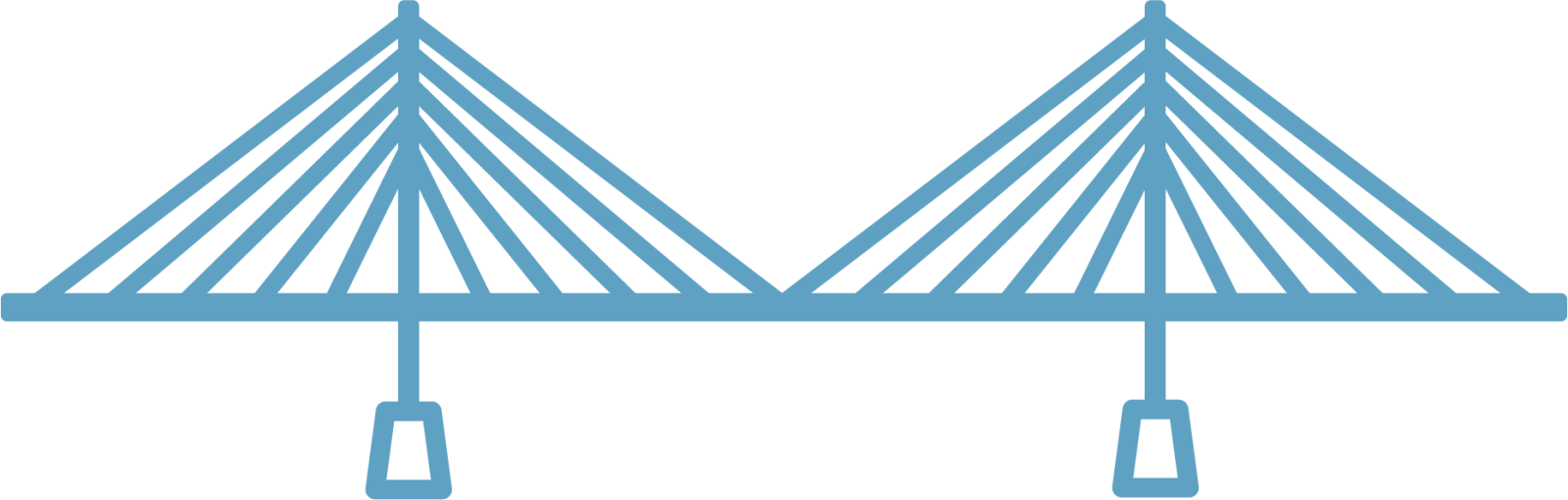
Suspension bridge bridges carry their stiffening deck from cables that hang in between tall towers. In their classical configuration, the main cables are suspended in a catenary and transfer loads to the towers and to the ground through anchorages at each end. This system allows very long spans to be achieved with a relatively lightweight superstructure.

Balanced cantilever construction, mostly adopted for post-tensioned concrete bridges, is a method used for building bridges where segments are either cast in place, or precast, and extended symmetrically from a central pier.

Incrementally launched bridges are constructed by progressively pushing [or pulling] sections of the bridge deck from one end across the piers using hydraulic jacks and sliding bearings. This method is efficient for building bridges over inaccessible terrain, minimising the need for temporary supports.

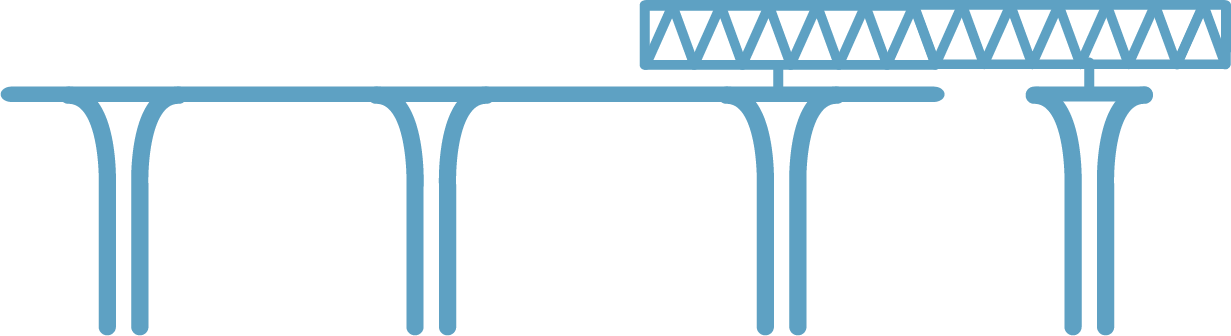
Span-by-span bridges are constructed by placing and post-tensioning precast segments, one full span at a time, typically using an overhead launching gantry. This method is efficient for repetitive spans and is suitable for long viaducts and elevated metro lines. Variants of this method can also feature fully precast spans and also cast in place spans.
Arch bridges perhaps one of the oldest forms of bridge construction, employ a vertically curved structure to transfer loads primarily through compression along the curve, thus efficiently distributing weight to the supports at either end.

Major bridge projects, particularly those involving a signature crossing and extensive approach structures, often require a combination of construction methods. For example, on a large bridge project in Central America where I acted as an independent expert, the works included a segmental cable stayed bridge, alongside approach spans constructed using balanced cantilever and incremental launching techniques.
The technical and risk landscapes featuring the above bridge types evolve around complex interactions between the human workforce and various types of temporary works, mobile plant, equipment, heavy lifting devices, cranes, and highly specialised gantries and form travellers, as well as the environmental factors such as wind, earthquakes, temperature variations and geotechnical conditions.
Evolving geometric and force profiles during erection
There are various issues that can be experienced when geometric and force profiles during erection can not only be different to those anticipated in-service but can even be opposite. For instance, bridges erected by incremental launching experience significant cantilevers and large stress variations during erection, even stress reversals, that would not occur in the operational life of the structure.
I recently led the Proof Engineering on a major project in Australia, which involved the construction of twin network arch bridges, each oriented on double skews. A novel technique was employed to incrementally launch the arches across a wide body of water, using a long space-truss launching nose. During the launching phase, the arches were engineered to accommodate cantilever behaviour. Following the completion of the launch, the structural system was gradually and systematically transitioned to a simply supported configuration for post-launch works and in-service conditions. The entire process was rigorously modelled using sophisticated computational techniques to analyse stress ranges, skew induced deflections, and the influence of onerous wind effects during launching.
Cable stayed bridges exhibit considerable complexity in the evolution of their geometric configurations and force profiles during erection. This complexity inherently arises from the significant disparities in the relative stiffnesses of the primary structural components. The situation becomes even more intricate when additional factors such as soil–structure interaction, dynamic vibrational behaviour [particularly wind-induced effects], thermal differentials, and various forms of age-related and geometric nonlinearities are also considered.
I led the Technical Design Audit of one of the biggest reinforced concrete cable stayed bridges in the world, located in Vietnam. The bridge posed a very interesting challenge in that only one set of mobile form travellers was used for constructing the superstructure. There was thus a time lag of more than one year between the constructions of the two halves of the reinforced concrete superstructure. The nonlinear age-related effects, such as creep and shrinkage, therefore had to be determined in considerable detail, using computerised modelling, to investigate geometric control for closing the record main span, and also long term effects on stress redistribution in the post-closure state.
Another iconic cable stayed bridge that I worked on as the technical project expert was for a metro project in Australia. The bridge featured a plan-curve superstructure, suspended by a centralised singular plane of cable stays. The bridge was constructed by a hybrid method, featuring precast balanced cantilever, as well as span by span erection, which I had proposed. The bridge went through distinct transitions of the statical system from construction stages to its final configuration. These transitory stages were modelled and monitored not only for geometric evolution, but also for force profiles.
In all the above instances, elaborate site surveys and monitoring was specified during the erection process. The analytical models were continuously benchmarked and appropriately updated in light of data received from the site.
Geometric incompatibility
One of the most challenging aspects of design, erection engineering, and construction is understanding the various geometries a structure can experience throughout its lifecycle. For example, the geometry of a structural member in the fabrication or precasting yard is likely to differ from its geometry during lifting and installation, and yet again from its final geometry in service.
If these geometric transitions, especially in the context of tolerances, are not properly understood, analysed, and accounted for during design and fabrication, or precasting, significant issues such as misalignment and lack of fit can arise. Corrective measures in such cases can be costly and time consuming, potentially leading to budget overruns and programme delays.
The locked-in state
Almost inevitably, certain geometric deformations and stress states induced during the erection process become locked into the structure, even after temporary works, erection equipment, and construction loads have been re-positioned or even removed. These residual effects can have significant short term as well as long-term effects that must be accounted for in the engineering. Recognising, analytically predicting, and managing these locked in effects is therefore critical to reliable erection engineering.
I was appointed as an independent expert consultant for a major cable stayed bridge in the USA, on which the development of forces and deformations in the composite structure were investigated in detail across the erection stages. It was found that the torsional rotations experienced by the edge girders during erection could progressively build up and become locked-in, at least partially. Specialised means were therefore investigated to redress and achieve the desired 3D geometry control and fit-up.
It is essential in the erection engineering of major bridges that elaborate protocols and procedures are not only specified, but rigorously implemented to ensure that there is constant flow of real life data, collected through site monitoring and surveys, back to the design office for review and updating.
Environmental loading
The investigation of integrity and stability of an 'under construction bridge' during the transient stages of evolving geometry and force profiles becomes significantly more complex when environmental loads are also considered. These include seismic, wind, temperature, differential temperature and differential temperature effects.
While seismic and wind design loads considered during erection are often lower in magnitude than those required for in-service conditions, their impact on a partially completed structure can be disproportionately severe. This is due to the reduced stiffness, incomplete load paths, and temporary support conditions. All of which make the unfinished structure more susceptible to large deflections, instability, and even collapse during erection.
Temperature and differential temperature effects also constitute a significant design consideration, sometimes more so for geometry control during erection. In some cases, these thermal influences govern alignment, fit up, and cable force optimisation more than they do in the final service condition.
For instance, I recently led the design reviews on a cable stayed bridge project in the Middle East, where significant geometric deviations due to differential thermal effects during erection were indicated by computer models. The preliminary analytical investigation indicated significant potential deviations from the targeted alignments if differential thermal effects were not appropriately accounted for in the geometry control specifications.
Environmental loading therefore introduces another dimension of complexity to the erection engineering of major bridges, amplifying the need for careful prediction, site monitoring, management and control during all stages of construction.
Computerised modelling and analyses
I have referred to computer models and analyses in the preceding sections. In modern practice, the use of computerised Finite Element Analysis [FEA] is fundamental to understanding and predicting the behaviour of major bridges across their entire lifecycle, including during erection. Advanced FEA has become one of the most powerful tools available to bridge engineers. Having used many of the high end proprietary platforms on the market, I have seen their analytical capabilities develop dramatically over the years. Contemporary software now provides sophisticated tools for staged construction analysis, a core requirement for assessing evolving geometry, force redistribution, and the temporary structural states that define erection engineering.
Many platforms offer integrated static and dynamic analysis, linear and nonlinear options, and the ability to model material nonlinearities with considerable precision. Several also include specialised modules for simulating key construction methods such as cable stayed, segmental balanced cantilever, span by span, and incremental launching. I have used these types of platforms not only for advanced analyses related with design and checking, but also for causative assessments in forensic work.
In addition, modern FEA systems incorporate code specific features for both force based and displacement based seismic analysis, nonlinear stability assessments, and studies of aerodynamic behaviour, ship impact, and cable loss scenarios.
Although the full potential of these integrations is still emerging, growing compatibility with BIM and parametric modelling environments, supported by rapid advances in automation and AI, is further enhancing the analytical landscape.
Concluding remarks - the significance of getting erection engineering right
Erection engineering sits at the core of major bridge construction, defining how geometry, forces, and temporary states evolve from the drawing board to completion. Each current stage brings a unique configuration, often more vulnerable, and markedly different from the final in service structure. Managing these transitions demands precision in analysis, careful control of tolerances, and a continuous flow of real time information between site and design teams.
When erection engineering is executed well, it enables safe construction, predictable behaviour, and the timely achievement of critical milestones. When it is not, the consequences can be disruptive and severe. Getting erection engineering right is not simply a technical requirement, it is a fundamental contributor to project certainty, risk management, and the successful delivery of a major bridge.
This article was originally written for issue 30 of the Diales Digest. You can view the publication here: https://www.diales.com/diales-digest-issue-30